India Bans Export of Lithium-Ion Battery Waste Containing Black Mass
· Source: The Hindu BusinessLine
Banning black mass exports supports India's circular economy in the EV sector, impacting supply chain management and sustainability data.
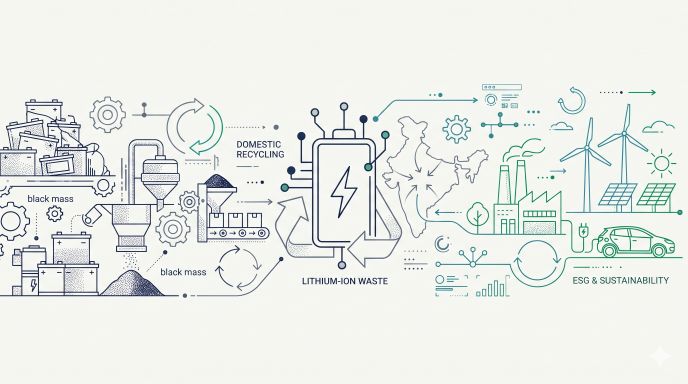
To fortify India’s domestic supply chain for critical minerals, the Directorate General of Foreign Trade (DGFT) has officially prohibited the export of lithium-ion battery waste and scrap containing "black mass." Executed through Notification No. 49/2026-27 in November 2026, the policy shifts the export status of these materials under ITC (HS) Code 85491400 from 'Free' to 'Prohibited' with immediate effect. This proactive measure ensures that the vital resources recovered from spent batteries remain within the country, fueling India's rapidly growing electronics, electric vehicle (EV), and renewable energy sectors.
Black mass is a highly valuable, powdery intermediate substance created by shredding end-of-life lithium-ion batteries and manufacturing scrap. It is rich in critical minerals like lithium, cobalt, nickel, manganese, and graphite. However, the overall economic value of black mass heavily depends on the original battery's chemistry. For instance, Nickel-Manganese-Cobalt (NMC) batteries yield highly lucrative metals, whereas Lithium-Iron-Phosphate (LFP) batteries lack nickel and cobalt entirely, making their recycling process far more economically challenging. Regardless of the underlying chemistry, retaining this material domestically is widely deemed a strategic manufacturing imperative.
The Ministry of Commerce and Industry's strategic decision aligns seamlessly with the broader goals of the National Critical Mineral Mission. It directly complements the government’s existing ₹1,500 crore incentive scheme designed to rapidly boost the production of critical minerals from secondary sources. By mandating that black mass is recycled and refined locally, the government aims to guarantee raw feedstock availability for domestic recycling plants, significantly improve their capacity utilization, and reduce the heavy foreign exchange outflow caused by ongoing import dependence.
Industry stakeholders have strongly supported the newly introduced restriction, viewing it as a major win for domestic manufacturing. The Material Recycling Association of India (MRAI) highlighted that the decisive ban is a foundational step toward long-term resource security, encouraging essential indigenous investments, and building a genuinely self-reliant circular economy. Current industry estimates indicate that India produces an overwhelming 3.2 million tonnes of e-waste annually. This vast amount includes approximately 70,000 tonnes of end-of-life batteries, which directly translates to a potential yield of 30,000 tonnes of black mass every single year.
Interestingly, data from the Global Trade Research Initiative (GTRI) shows that India actually recorded zero exports of this specific HS code globally in the 2026 financial year. Therefore, this ban largely functions as a forward-looking safeguard to prevent future material drain as global demand and prices inevitably spike. GTRI founder Ajay Srivastava cautioned that robust customs enforcement will be absolutely vital to the policy's success. He noted that unscrupulous exporters might attempt to bypass strict hazardous-waste regulations by misclassifying black mass as basic industrial products, such as cobalt powder or nickel intermediates.
To minimize immediate business disruption, the DGFT clarified that transitional arrangements under Paragraph 1.05 of the Foreign Trade Policy 2023 will still apply to pre-existing legitimate export commitments. Ultimately, this strategic export ban mirrors similar protective measures taken by other major global economies. By actively tapping into these discarded batteries as a rich "urban mineral resource," India ensures its transition to clean energy, advanced chemistry cells, and sustainable mobility is powered by its own recycled reserves rather than vulnerable international supply chains.
Read the original at The Hindu BusinessLine
Drafted with AI help, then checked by a person against the source. How we make News
Go deeper
Is your company asked for BRSR data?
Take the one-minute check to see whether BRSR applies to you.
Check if BRSR applies