Global Frameworks
CBAM for Indian Exporters: What the EU's Carbon Border Rules Ask of You
The EU's carbon border tax (CBAM) now applies to steel, aluminium, cement, fertilisers, electricity and hydrogen. What it means for an Indian supplier.
TL;DR
CBAM (the EU's Carbon Border Adjustment Mechanism) puts a carbon price on certain imports. It applies in its full form from 1 January 2026 to cement, iron and steel, aluminium, fertilisers, electricity and hydrogen. The EU importer, not you, buys the certificates. But the importer needs the carbon emissions of your product, so expect them to ask you for data. Indian exporters who can show measured numbers are better placed than those left with EU default values.
Who this is for
An Indian manufacturer or trader that sells steel, aluminium, cement, fertiliser or products made from them to a buyer in the European Union, and has just been asked for "embedded emissions".
Plain explanation
Some countries charge companies for their carbon pollution, as the EU does through its Emissions Trading System (EU ETS). To stop companies from simply moving production to countries with no such charge, the EU wants imports to carry the same carbon cost. That is CBAM.
Embedded emissions are the greenhouse gases released while making the goods. They are measured in tonnes of CO2 equivalent per tonne of product. They count the emissions at your plant (direct), plus those of the materials you bought in to make the goods (the Regulation calls them precursors), such as the steel wire behind a bolt. For some goods they also count the emissions from the electricity used (indirect). Annex II of Regulation (EU) 2023/956 lists the goods where only direct emissions are taken into account, including iron and steel and aluminium goods. Cement and fertilisers are not on that list, so for them electricity counts too. Check the current rules, because this part is under review.
The Commission says CBAM ran in a transitional phase from 2023 to 2025 and applies in its definitive regime from 1 January 2026. Importers of CBAM goods, or their indirect customs representatives, must be authorised, report the emissions embedded in their imports, and buy and surrender CBAM certificates for them. The certificate price follows the EU ETS auction price: a quarterly average in 2026, and a weekly average from 2027. If a carbon price was already paid where the goods were made, it can be deducted.
India specifics
Who pays. Importers who bring in more than a single mass-based threshold of 50 tonnes of CBAM goods a year must be authorised declarants and buy certificates. You, as an exporter, do not buy them. The cost reaches you in a price talk with your buyer, or in a request for data.
Which goods. The Commission lists the sectors: cement, iron and steel, aluminium, fertilisers, electricity and hydrogen. The lists are by product code (CN code) and include some finished articles. For example, Annex I of the original Regulation (EU) 2023/956 lists screws, bolts and nuts under CN 7318 in iron and steel. Check your exact code against the current list on the Commission's site, because it can be extended.
Data and proof. If you give no emissions data, the importer must use EU default values. Real, measured numbers can be lower, and they are verified by accredited verifiers. The Commission has a verification section and publishes the default values and benchmarks for 2026.
What to ask your buyer. Which CN codes, what period, which format, and whether they need a verified report.
Worked example
Meera's fictional fastener factory in Ludhiana makes bolts under CN 7318 and ships 100 tonnes a year to a German distributor.
Bolts are in iron and steel (Annex II), so only direct emissions count, and the emissions of the steel wire rod she buys. Her steel supplier gives her a figure of 1.9 tonnes of CO2e per tonne of wire. Her own plant (fuel for heat treatment) adds 0.1 tonne per tonne of bolts. Together that is 2.0 tonnes of CO2e per tonne of product, so 200 tonnes a year for 100 tonnes of bolts. (All figures here are made up to show the arithmetic.) For the plant's own fuel use the method in our emissions guide; the steel figure comes from your supplier.
For illustration only: at an assumed EU carbon price of €70 per tonne and ₹100 to the euro, 200 tonnes would be €14,000, about ₹14 lakh (₹1,400,000). The importer, not Meera, would pay that, and it would be lower if free allowances or a carbon price paid in India are deducted. If she gives no data, the importer uses a default value that may be higher. So her buyer prefers a supplier who can send a measured figure.
Checklist
- Find the CN code for each product you export to the EU and check it against the Commission's current CBAM list.
- Ask your buyer what they need: period, format, verified or not.
- Measure your plant's direct emissions (fuels), and ask your suppliers for the emissions of the materials you buy. Add electricity only where the rules count it. Then divide by tonnes produced.
- Keep the records: bills, fuel purchases, production registers.
- Ask about an accredited verifier if your buyer wants a verified report.
- Watch the Commission's CBAM page for changes to goods, defaults and dates.
What to do next
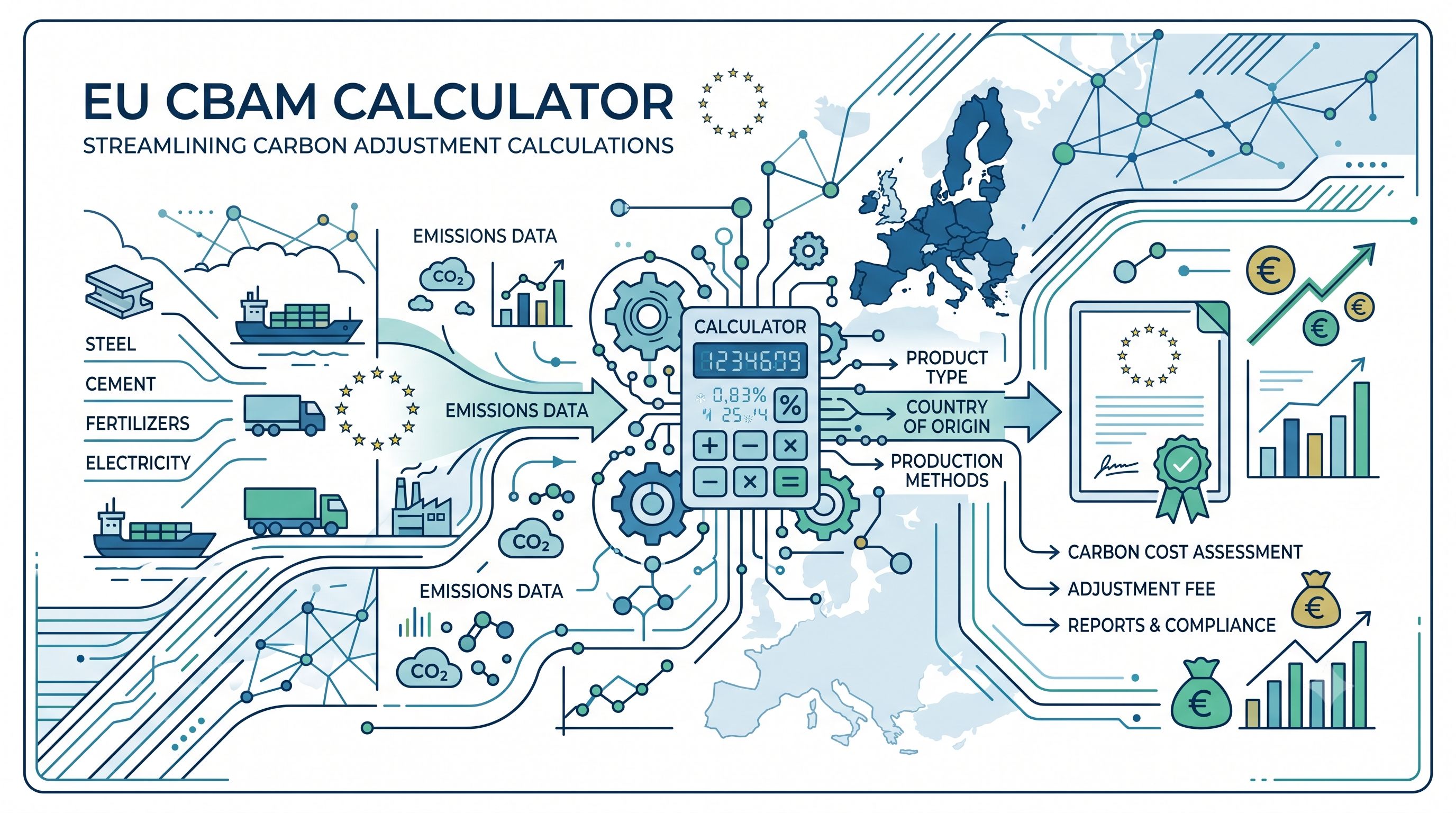
Our CBAM calculator gives a first estimate of embedded emissions from your inputs. It is an estimate, not a verified report.
Current as of: 14 November 2026. Checked against the European Commission's CBAM pages (definitive regime from 1 January 2026; 50-tonne threshold; sectors; certificate pricing) and Regulation (EU) 2023/956. The rules have been amended and may be extended, so treat any date more than 12 months old as due for a recheck. This guide is general information, not legal or customs advice.
Sources: