How-to & Measurement
How to Answer an ESG Questionnaire: Sample Answers to the 15 Most Common Questions
Fifteen questions that appear on almost every supplier ESG form, what the customer really wants to know, and honest sample answers you can adapt.
TL;DR
Most supplier ESG forms ask the same fifteen things: energy, emissions, water, waste, your people, safety, wages, child and forced labour, grievances, policies, bribery, data privacy, your own suppliers and certificates. Answer with a real number and a one-line source. Where you do not track something yet, say so and say what you will do. An honest "not yet" reads better than a guess.
Who this is for
A supplier with a customer's ESG form open in another window and a deadline. If you have not read it yet, start with our guide on what to do when a customer sends you an ESG questionnaire, then come back here for the wording.
Plain explanation
Forms differ, but listed customers draw their questions from the same source: the BRSR (Business Responsibility and Sustainability Report) that SEBI (the Securities and Exchange Board of India) requires of them. Its format, Annexure 16 of the Master Circular, and the shorter BRSR Core list ask for the same kinds of facts. So the fifteen below cover most of what you will meet.
Each answer has the same shape: a number, the period, where it comes from. Keep the proof (a bill, a register, a policy page) in one folder. Our guide on collecting ESG data without a sustainability team shows how.
The fifteen questions
Environment
- "What was your electricity use last year?" They want kilowatt-hours (kWh), not rupees. Sample: "In FY 2025–26 we used 182,400 kWh, from 12 monthly bills of our distribution company."
- "How much of it is renewable?" Sample: "About 9% (16,400 kWh) from our rooftop solar, read from the inverter. The rest is grid power." If you have none: "None at present."
- "Do you measure greenhouse gas (GHG) emissions?" Sample: "We have calculated Scope 2 for FY 2025–26 using the Central Electricity Authority grid factor: 123 tonnes of CO2e. Scope 1 and 3 are not measured yet; Scope 1 is planned for next year." See our Scope 2 worked example.
- "How much water do you use, and where does it come from?" Sample: "About 2,100 kilolitres a year from the municipal supply, from our water bills. We have no borewell."
- "How do you handle waste?" Sample: "Metal scrap (about 14 tonnes) is sold to an authorised recycler; used oil goes to a registered collector. We keep the receipts." Name the recipient and keep the paper.
People
- "How many people work for you?" Say permanent and contract workers apart, and men and women apart. Sample: "62 permanent (48 men, 14 women) and 21 contract workers on 31 March 2026."
- "What is your safety record?" Sample: "Two lost-time injuries in FY 2025–26, none fatal. We keep an accident register." Lost-time injury frequency rate (LTIFR) is injuries divided by hours worked, times 1,000,000. Give it only if you can calculate it.
- "Do you pay at least the minimum wage?" Sample: "Yes. All workers are paid at or above the state minimum wage. Wage registers are available for audit."
- "Do you use child or forced labour?" Sample: "No. We verify age proof at hiring and do not hold identity documents or deposits." Say only what is true.
- "Do workers have a way to raise complaints?" Sample: "Yes: a complaint box and a named HR contact, reviewed monthly. We received three complaints last year, all closed."
Governance
- "Do you have a code of conduct?" Sample: "Yes, approved by the proprietor/board on 1 April 2025 and given to all staff." See the policies a small company needs.
- "Do you have an anti-bribery policy?" Sample: "Yes, a one-page policy within the code of conduct. No cases were reported."
- "How do you protect personal data?" Sample: "We hold employee records on password-protected systems; access is limited to HR. We have no customer personal data."
- "Do you check your own suppliers?" Sample: "We have a short supplier declaration for our top five suppliers (about 70% of purchases). Full assessments are planned."
- "Which certificates do you hold?" Sample: "ISO 9001 (valid to March 2027). We do not hold ISO 14001 or 45001." List only valid ones, with dates.
India specifics
Where a number matters, use Indian sources: electricity from the bill, the grid emission factor from the Central Electricity Authority, wages against your state's minimum wage notification, and waste against your State Pollution Control Board authorisation if you have one. Quote the financial year, April to March.
Worked example
Kavita runs an 83-person sheet-metal workshop (fictional) with sales of about ₹18 crore (₹180,000,000). Her customer's form has 25 questions. She answers 17 with real numbers from her records in one afternoon. For the other eight she writes "not tracked yet" and adds a date: "We will start recording water use from the 1st of next month." The customer's team asks two follow-ups and treats the form as complete.
Checklist
- Copy the customer's questions into one document and tick the fifteen above that match.
- For each, write: number, period, source.
- Put the proof in one folder and name each file after the question.
- For gaps, write what you will do and by when.
- Never round up or guess a figure you cannot show.
- Save the answers once, so the next customer's form takes an hour.
What to do next
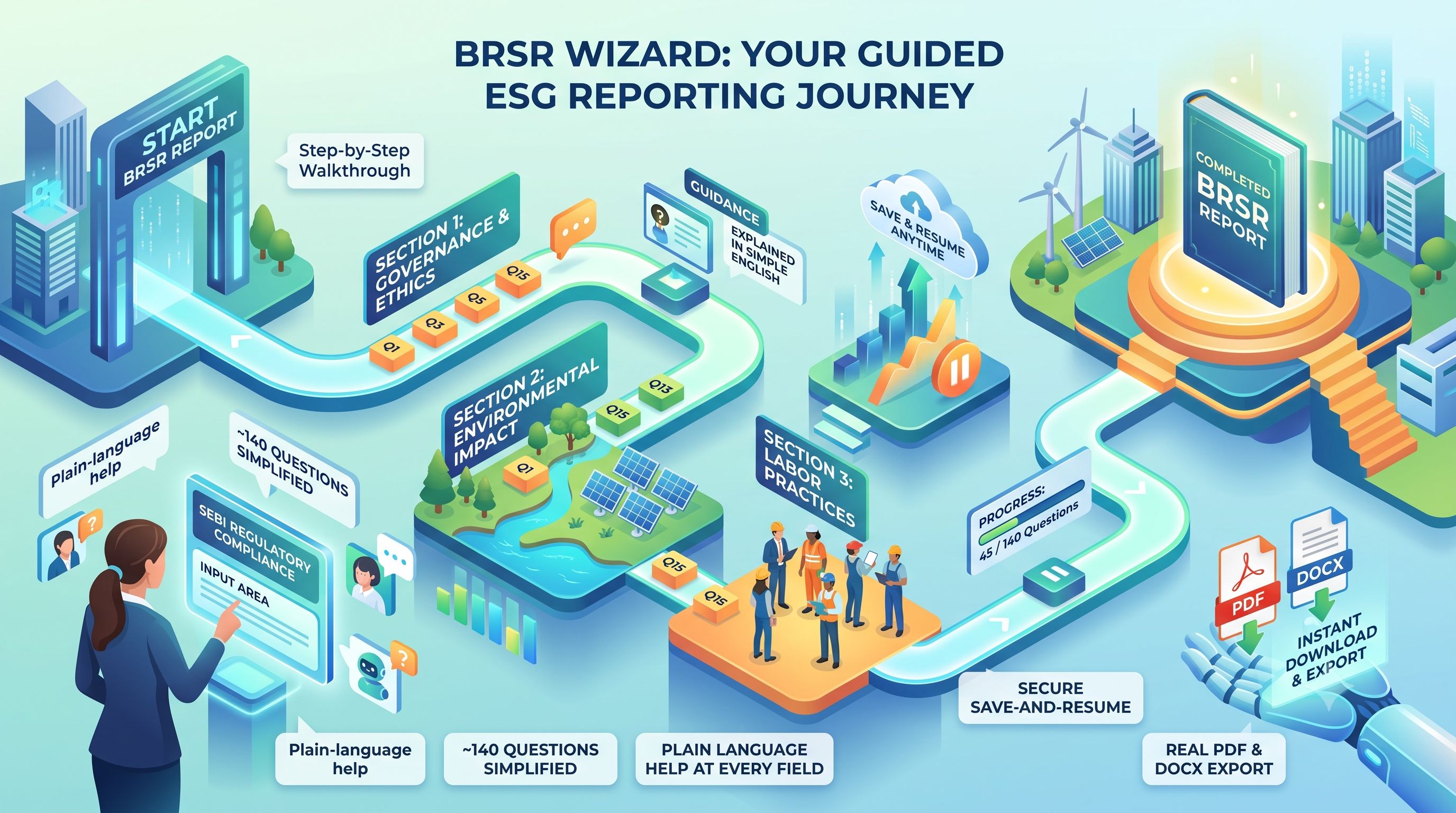
Keep your answers in one place so you can reuse them for every customer. The BRSR wizard saves them for you, with plain-language help on each question.
Current as of: 14 November 2026. The sample answers are examples, not templates to copy: use only what is true for your company. The BRSR questions referred to are in SEBI's Master Circular of 30 January 2026 (Annexures 16 and 17A). This guide is general information, not legal advice.
Sources:
- SEBI LODR Master Circular, 30 January 2026, Annexure 16 (BRSR) and Annexure 17A (BRSR Core)